The real cost of Termite protection for timber decking and wooden roof trusses: Chemical vs. baiting systems: hidden expenses revealed
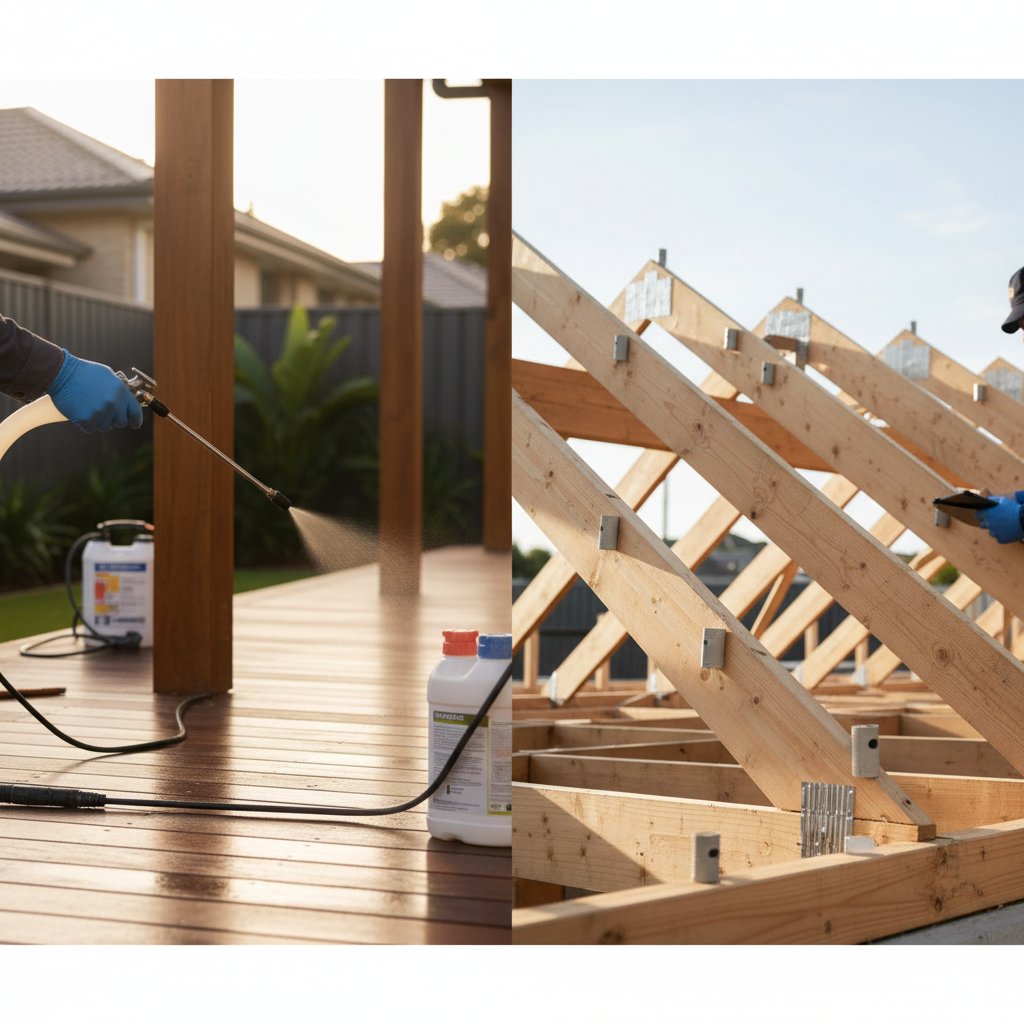
The $15,000 Surprise Nobody Warned You About
My neighbor Rick thought he'd scored a deal on his dream deck. Brazilian hardwood, gorgeous craftsmanship, the works. Three years later, he's staring at $18,000 in termite damage plus replacement costs. The kicker? His "comprehensive" chemical barrier treatment had expired after five years, something the installer mentioned once during signing and never again.
Rick's story isn't unique. Across Australia and the US, homeowners drop serious cash on timber decking and exposed wooden roof trusses without fully grasping the long-term economics of keeping termites at bay. The upfront quotes look reasonable enough. It's the hidden expenses, renewal fees, and "gotcha" moments that'll make your wallet weep.
Two Camps, Wildly Different Price Tags
Chemical barriers and baiting systems represent fundamentally different philosophies—and cost structures. Think of chemicals as building a moat around your castle. Baiting systems? More like setting strategic traps and monitoring stations.
A typical chemical treatment for a standard suburban home runs $1,500 to $3,500 upfront. Sounds manageable. But here's what the brochures don't shout from the rooftops: most chemical barriers need reapplication every 5-8 years. That's another $1,200-$2,800 per treatment cycle. Over a 30-year mortgage, you're looking at $6,000 to $14,000 in recurring costs.
Baiting systems flip the script entirely. Installation typically costs $2,500 to $4,500—higher upfront, sure. But the annual monitoring and maintenance? Usually $300-$500 per year. Do the math over three decades, and you're spending $11,500 to $19,500 total.
The Devil's in the Maintenance
Chemical treatments create an invisible shield in the soil around your home. When it works, it works brilliantly. Termites hit the barrier and turn back. Problem solved, right?
Except soil shifts. Foundations settle. That landscaping project you did last summer? You might've accidentally created gaps in your chemical barrier. Most homeowners have zero idea their protection has been compromised until they spot mud tubes climbing their deck posts.
Dr. Sarah Chen, an entomologist who's studied termite behavior for 15 years, puts it bluntly: "Chemical barriers fail silently. There's no warning system. Homeowners assume they're protected because they paid for treatment five years ago, but termites don't care about your receipt."
Baiting systems require quarterly inspections—which means quarterly fees. That's the part that makes people grumble. But those inspections catch termite activity early, often before any structural damage occurs. You're essentially paying for peace of mind and early warning radar.
Hidden Costs Nobody Mentions Until It's Too Late
Both systems come with sneaky expenses that rarely make it into initial quotes:
- Retreatment after construction work: Adding that deck extension? Your chemical barrier needs topping up. Figure $800-$1,500.
- Annual inspections: Even with chemical treatments, smart homeowners pay $200-$350 yearly for professional inspections. Your warranty probably requires it.
- Bait station replacements: Stations get damaged by lawn mowers, weather, and curious dogs. Replacement runs $75-$150 per station.
- Emergency call-outs: Spotted suspicious activity between scheduled visits? That's $150-$300 for an unscheduled inspection.
The Roof Truss Complication
Wooden roof trusses present a special nightmare. They're harder to access, harder to treat, and when termites get in, the damage can be catastrophic. Chemical treatments for roof spaces often require drilling and injection, adding $500-$1,200 to standard quotes.
Baiting systems can't directly protect elevated timber. You're relying on ground-level stations to intercept colonies before they venture upward. This works—termites typically forage from the ground—but it requires religious maintenance of those monitoring stations.
One Brisbane builder I spoke with shared this gem: "I've seen $60,000 roof repairs from termite damage that could've been prevented with $400 worth of annual monitoring. People think they're saving money by skipping inspections. They're not."
What the Numbers Actually Tell Us
According to industry data, roughly 1 in 3 Australian homes will experience termite issues at some point. The average repair bill sits around $7,500, but severe cases easily hit five figures. In the US, termites cause $5 billion in property damage annually.
Here's the uncomfortable truth: neither system is "better" in absolute terms. Chemical barriers offer immediate, comprehensive coverage but require vigilant reapplication. Baiting systems provide ongoing monitoring and colony elimination but demand consistent maintenance investment.
Your actual costs depend on factors most quotes ignore: soil type, local termite pressure, proximity to bushland, timber types used, and how obsessive you are about maintenance schedules.
Key Takeaways
- Chemical treatments cost less upfront ($1,500-$3,500) but require reapplication every 5-8 years
- Baiting systems run $2,500-$4,500 initially plus $300-$500 annually for monitoring
- Over 30 years, total costs range from $6,000-$14,000 (chemical) to $11,500-$19,500 (baiting)
- Hidden expenses—retreatments after construction, emergency inspections, warranty requirements—add 20-35% to base costs
- Wooden roof trusses need specialized treatment approaches, adding $500-$1,200 to standard quotes
- Annual professional inspections are non-negotiable regardless of your chosen system
Rick eventually went with a baiting system for his rebuilt deck. He hates the quarterly fees, but he loves the inspection reports that confirm he's termite-free. Sometimes the expensive lesson is the one that sticks.